


Control and Connection Cables
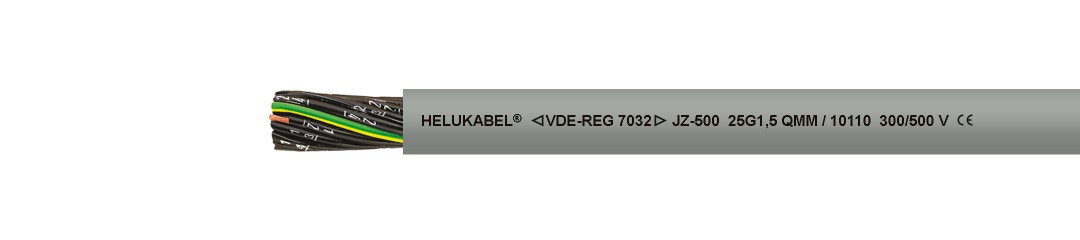
Control and connection cables have two or more cores and are suited for many applications. These cable types are used in many industries, such as in mechanical and plant engineering, drive and automation technology, control cabinet engineering, or in robotics. They are also found in electronic household appliances and tools, as well as in the transportation, infrastructure, and energy sectors.
What is a control cable?
Control cables transmit signals within a control circuit which controls different components. They are used in both the internal and external wiring of components ranging from machines and facilities to sensors and actuators. Control signals instruct the receiver of the signal to perform a specific action.
Control cables are available with between two and 100 colour or number-coded cores. In most cases, each core has a cross-section ranging from 0.5 to 2.5 mm². Typically, the sheath is made of PVC or PUR.
What sets us apart—at a glance
- Wide range of applications: whether in machines, robots, or control systems, our cables reliably transmit energy and signals to their destinations
- High resilience: depending on the type of cable, they can withstand oils, chemicals, weathering, and movement
- Pre-assembled designs: numerous materials, cross-sections, and core counts are available
- Custom fabrication: we develop cables that are perfectly tailored to the technical requirements of your application
- Compliance with standards for international markets: with UL, CSA, HAR, and Ex approvals, our cables are ready for use around the globe
What is a connection cable?
Connection cables are responsible for transmitting electrical energy in machines, facilities, and appliances. They are used to supply energy to buildings and to distribute energy in power plants and transformer stations. Connection cables are also commonly referred to as energy cables, electricity cables, supply cables, or power cables.
Connection cables typically have between two and five colour-coded cores. In most cases, each core has a cross section of 2.5 mm² or larger. PUR and PVC are also the most common sheath materials for connection cables.
What kinds of control and connection cables are there?
Some of the most common challenges faced by control and connection cables are dynamic movements, tensile loads, bending, and torsion, for instance when used in drag chains or on industrial robots. The cables must therefore be both flexible and resilient to oils, chemicals, weather, and UV radiation. In many applications, screened control and connection cables are required to avoid disruptions related to electromagnetic compatibility (EMC).
Due to the wide range of applications and requirements, many different variations of control and connection cables are available with different numbers of cores and nominal cross-sections:
Discover our control and connection cables
In addition to an extensive portfolio of reliable and high-quality, standard solutions, HELUKABEL also manufactures custom control and connection cables according to the customer's needs. This is how we reliably and efficiently support our customers in realising complex and extraordinary projects.
Send us your individual request and our experts will contact you. Contact form
You can find all our catalogues, flyers, and brochures in our Download Centre.
FAQ
Yes, in addition to our wide range of standard products, we also deliver complete, pre-assembled control cables that are tailored according to your specific application and are installation ready.
Of course! We manufacture control cables according to customers' specific needs—whether custom lengths, special core colours, or other adjustments for specialty applications.
Control and connection cables are used anywhere where signals or energy must be reliably transmitted, for instance in mechanical engineering, automation, robotics, control cabinet engineering, household appliances, mobility, infrastructure, and in the energy sector.
Control and connection cables are also available in screened varieties, as well as in intrinsically safe, halogen-free, drag-chain-compatible, or HAR-approved designs (HAR: Harmonized Approval for Cables) which cover a range of requirements pertaining to EMC, safety, and load rating.
More Products for Industrial & Machinery Sector:



HELUKABEL News
Would you like to receive exciting insights into the world of HELUKABEL? Then subscribe to the HELUKABEL newsletter.